Saturday, April 07, 2007

The Elephant Form


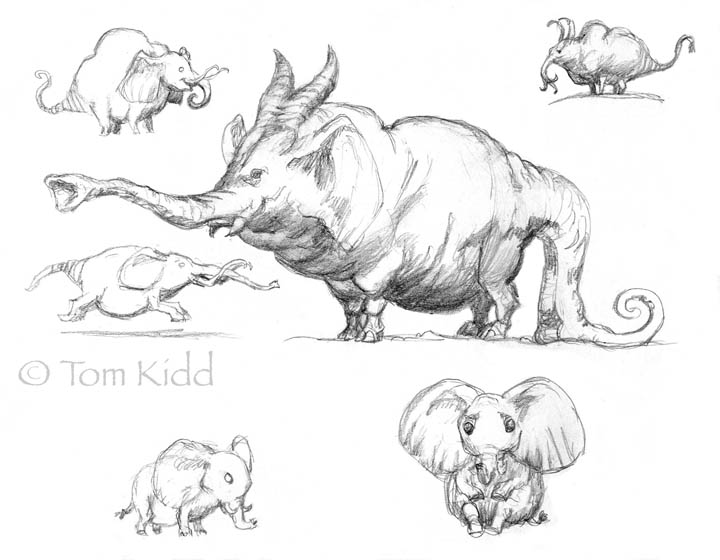
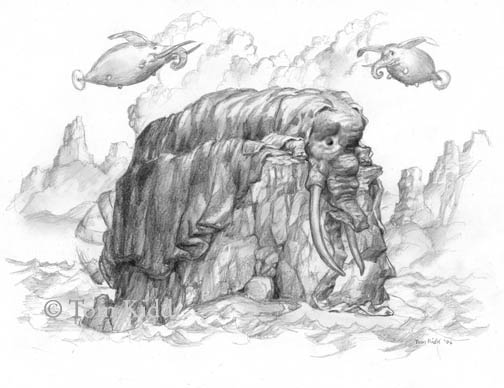
It took me a while but I put up a massive post to Gnemo's Sketchbook. I guess you could call it a small short story with illustrations. Please go there and look at that. The story was written around existing pictures. Now that I've written it though, I'm thinking I'll do a few more drawings on the subject. Above are just a few elephant forms. I may have posted these before. It's here just to get you to go see more over at my Gnemo blog.

Labels:

Monday, March 26, 2007

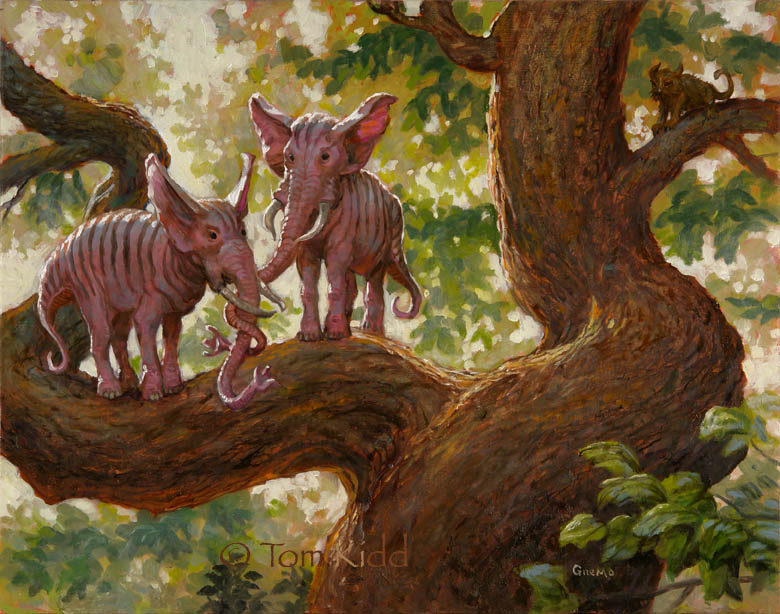
Marsulephants


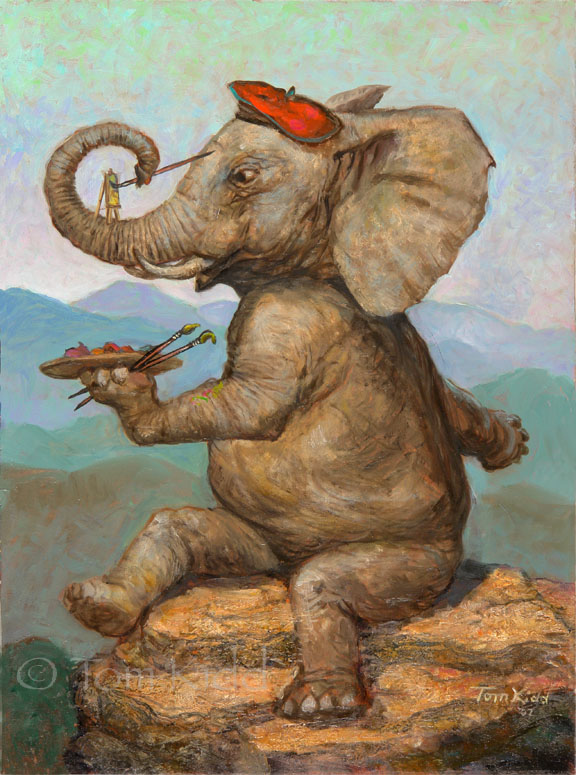
I forgot to mention in my previous elephant post that "Plein Air Pachyderm" is 8X11 inches. That's a pretty small painting for me. I plan to do more though.

This one is 11X14 inches and more properly belongs in my Gnemo's Sketchbook blog. I'm posting it here because I'm on the theme of elephant forms. The link for Gnemo's Sketchbook is to your right under the link to my website. In the next couple of days I'll post it there again with the full story of the marsulephants and a few marsulephant drawings. It's too late and I'm too tired to write about these creatures and the symbiotic relationship they have with booth trees they live in.

Why, someone might ask, do I have two blogs and who is this 'Gnemo' who signed this painting? I'm too tired to explain and just about everyone is tired of hearing it anyway.

Labels:

Thursday, March 22, 2007

Plein Air Pachyderm


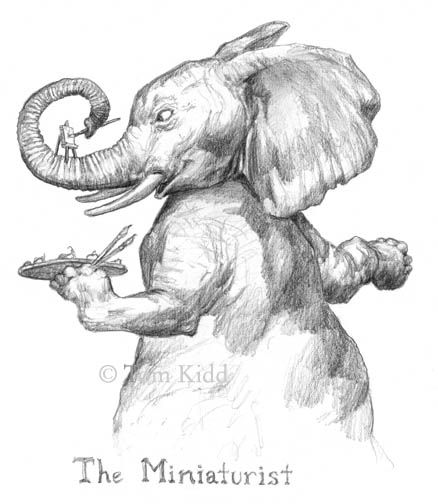
This elephant miniaturist is dedicated to my outdoor painting and drawing friends:

William Wray
Laurent Beauvallet
William K. Moore
Jennifer McChristian
Leslie Sealey

I'm still pretty busy but I hope to start posting again regularly. In the meantime you can check out the beautiful work of the artists I've provided links for. Please tell them I sent you.

Labels:

Wednesday, January 31, 2007

Percival the Puny Painting Pachyderm


Anna and Percival are artists, explorers and natural scientists. Above we see Percival painting one of his tiny paintings. Anna, who is also a prolific inventor, ground the pigments for his paints. She also invented brushes, the easel, stretched canvas and the pallet that this hairless dwarf mastodon is using. Percival is known for his fine trunk/eye coordination, which is quite handy (actually, better than a hand) when doing miniature painting.

Below is a roughed out page from the graphic novel when Anna and Percival first meet. You should get a larger, more readable, version if you click on it.

Labels:

Tuesday, December 05, 2006

Helioderms 103: Deflated


Call me the Walter Keane (actually, his wife Margaret is the real painter of those big-eyed kids) of fantasy if you like but the fact is that young mammals (even if they lay eggs) are cute. In this case, the eyes are even sad.

I guess we can all get deflated from time to time but for a blimpephants it’s literal. I’m thinking that there may be a children’s book here.

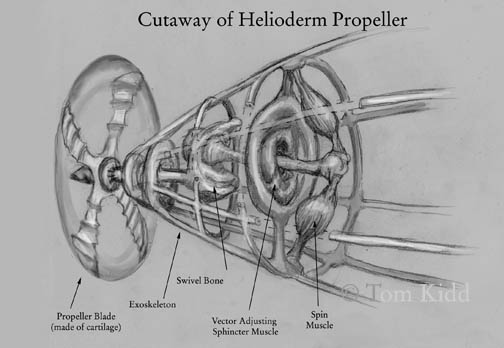
To balance out the cute I’m including a cross-section of a helioderm propeller. Whenever I create an animal I like to imagine it inside and out. Sometimes it helps my drawing but I do it mostly for the fun of it.

Labels:

Monday, December 04, 2006

Helioderms 102 & Gnemo's Sketchbook

First, I've updated my very clumsy website (I really don't know what I'm doing) with a Gnemo's Sketchbook section. There's a link to that above and I'll add a link to it on my Gnemo's Sketchbook blog soon.


Helioderms 102:

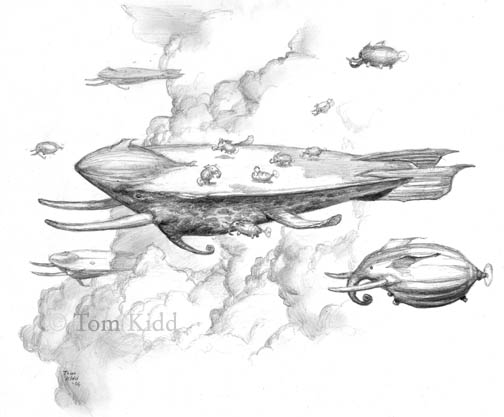
Besides being a form of pilot fish to the larger zepploderms, blimpoderms (pressure-shaped helioderms) also form a much more sophisticated type of symbiotic relationship with their massive cousins. This alliance is most similar to the bond between cecropia trees and azteca ants of Central America.

Like the cecropia trees the giant maconderms, also called carrier-phants, have evolved an environment that is especially conducive for smaller helioderms. The tops of their outer envelopes are largely hard and flat surfaces that the blimpoderms can land on, grapple to with their extendable toes and feed on the moss that grows on top. Removing the moss keeps the maconderm streamlined and adds variety to the blimpoderms diet. The maconderm (named after the Navy airship Macon, an internally rigid airship aircraft carrier used in the 1930’s) even provides little warm pockets for the blimpoderms to lay their eggs.

In exchange for this aerial nursery the blimpoderms defend the maconderm against all assailants, especially hungry dragon packs. Blimpoderms have a variety of weapons and battle techniques: they dive bomb to drop their own body waste on attackers, they have an internal ignitable gas that they use and they will also spurt out helium in small bursts to put out dragon fire. If enough helioderms are present they will work together to asphyxiate a dragon by releasing an inert gas mixture to envelope the dragon cutting off its air supply and ability to ignite its own gas.

The gargantuan maconderms troll the skies sucking up vast quantities of insects much like whales do with krill. One additional service the blimpoderms provide is fruit to the otherwise all-insect diet of the maconderm. Expectant parents fly to its lower trunk and hand off large fruit laden branches in exchange for the best nesting spots.

Labels:

Friday, December 01, 2006

Helioderms 101


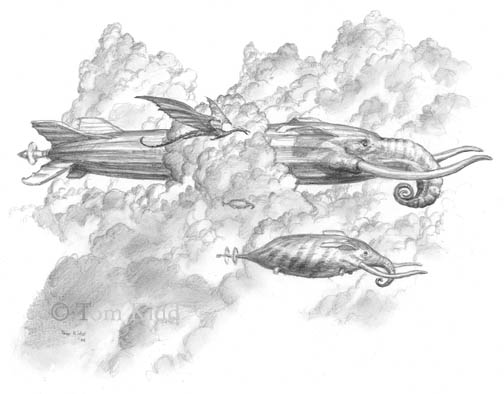
These beautiful lighter-than-air creatures fly the skies of a world not too distant from ours called Deutro. Their multilayered expandable skin is virtually impermeable to any gas. It’s this skin that allows them to float high in the atmosphere and it’s the special pebbled texture of this animal’s epidermis that creates micro air swirls that greatly decreases the natural drag of the air that flows over them. Despite their great volumes the helioderms cut through the air like an arrow.

Their tusks might seem like an odd evolutionary adaptation for a flying creature but the “tusks” are actually extremely porous helium processors. They remove all heavier noble gasses and chemically active gasses. Helium, which is all that is left, is absorbed into the helioderm’s envelopes – internal lightweight gasbags.

This is a heavily forested planet with unusually massive and dense trees. Most helioderm species eat by grazing the tops of these trees using their long extendable trunks to reach deep within them.

Their only natural enemy is the fire-breathing dragon. The dragons are considerably smaller than the helioderms and will only attack the weak and the young. Typically the smaller blimpoderms live in a symbiotic relationship with larger zepploderms. More on that in my next installment.

Labels:

Sunday, November 19, 2006

Small Works Show & Helioderm

You might want to skip over my rambling and go straight down the the pictures. I won't know if you do.

Where does it come from? I think that everything in the universe rolls around on giant wobbly wheel called time. There’s something about the crisscrossing pattern of all those unpredictable waves of tire tracks that cause a buildup of greater and greater complexity.

No, that analogy is too simplistic. There are likely 9 to 12 dimensions you have to include to have an appropriate matrix. That illustrates why it’s so difficult to predict what will happen next. Still, you can see a growth of overlaying interactions that generate new and increasingly intricate forms from the big bang up until the present.

We humans, as part of the universe, create new patterns every second of the day because of our varied interactions. We are the most complicated of creatures with our cultures, societies, arts and political systems. Sometimes we think we know the exact direction we’re going in but don’t be fooled, you’re not really in control so it’s best to see all the surprises as opportunities and see where they’ll lead you.

What the hell am I talking about? A week ago I didn’t know I’d do this painting. It didn’t have any life at all. Friends made it happen. I had to do a brand new painting for a miniature show scheduled for December at the Art Corner Gallery (click on the link above) in Salem, MA. All my smaller paintings are in a show at the Center for the Arts in Homer, New York. A million little ideas went through my head: what shall I paint, what shall I paint? I’ll decided to do something cute but weird. Then I remembered the drawings I posted here on my blog and that people liked them. Scroll down to “Silly Stuff” if you don’t know what I’m talking about.

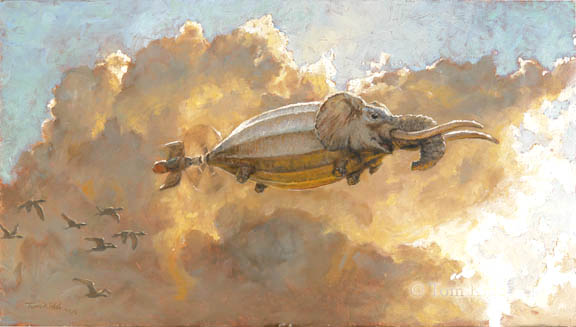
Here’s a step by step in three little steps. This painting is 8X14” and it was done in oils.

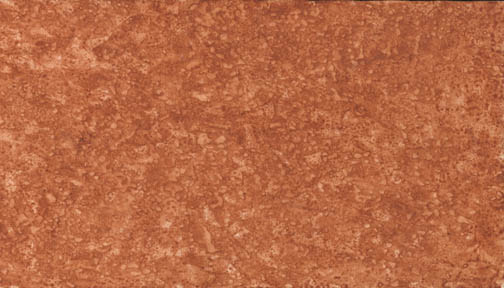
I did this first texture layer with watered down acrylics using a rag and dabbing. Sadly much of this was obscured in the painting process. I’d hoped to see more showing through but if you saw the original you’d see more than you can see here. It was actually done over a year ago and was waiting for me to decide what I’d paint on it. I put down a thin layer of drying linseed oil and I began painting (below).


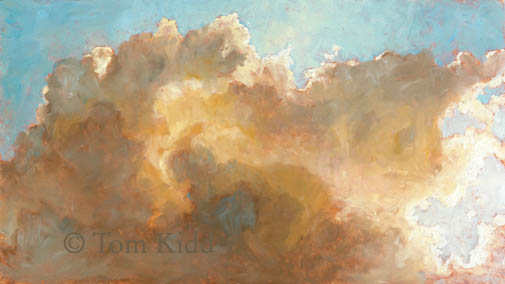
I study and photograph clouds all the time. They fascinate me because they are governed by simple principles, yet they make large convoluted things of tremendous beauty. One day I hope to write an elegant algorithm to explain it. It’s likely a vain hope but till then I can still admire and ponder them. This sky came from observation and many pictures I’ve taken. It went in quickly (below).


While the sky was still wet I painted in my helioderm – a creature of my own invention. I had put some alkyd white on my pallet so it would dry some and get gooey. That’s what I used for my ‘heavy’ whites that I used in the rim lighting. I didn’t add the birds till the next day when I also lightened the sky some. It actually looks darker here. I don’t know why (below).


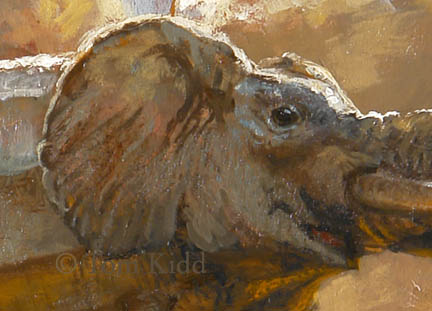
Here’s a close-up of the face. It took a few tries to get the exact level of cuteness I wanted. I’ve worked out in my mind the internal anatomy of this creature but I’ll save that explanation for another day. If all goes well I’ll do and post more helioderms.
Labels: